

As we enter the third year of the pandemic, the JIF (Journée internationale des femmes) platform announces its third women’s strike, which will take place on the 8th of March.
While political leaders everywhere agree that women’s work has been essential for maintaining economic and societal links in these times of crisis, no social progress has in fact been made in terms of wages, working conditions, recognition and balancing unpaid labour, reducing gender-based violence, access to housing and health and redistributing wealth.
We haven’t seen any significant social progress that would allow for lasting change to the economic system and the institutions that oppress the large majority of people for the profit of the few. None of the political promises made at the beginning of the pandemic to value women’s work and to share care work equally have been kept.
Women continue to be largely overrepresented in paid care work. They have been at the forefront of the pandemic, looking after children and the elderly as well as caring for the sick and the most vulnerable. Nurses, social workers, service workers, midwives, educators, cleaners and domestic workers are predominantly female and have been systematically undervalued.
The public health sector continues to be privatised. Housing prices are soaring and socio-economic inequalities have exacerbated. The poor have become poorer and the rich have increased their wealth. On top of that, women still take on the majority of unpaid care work in the home as well as in interpersonal relationships. The load of domestic and educational work within the family often still falls on women. We witness how the oppression of women is played out in the most violent way in the case of rape and feminicide.
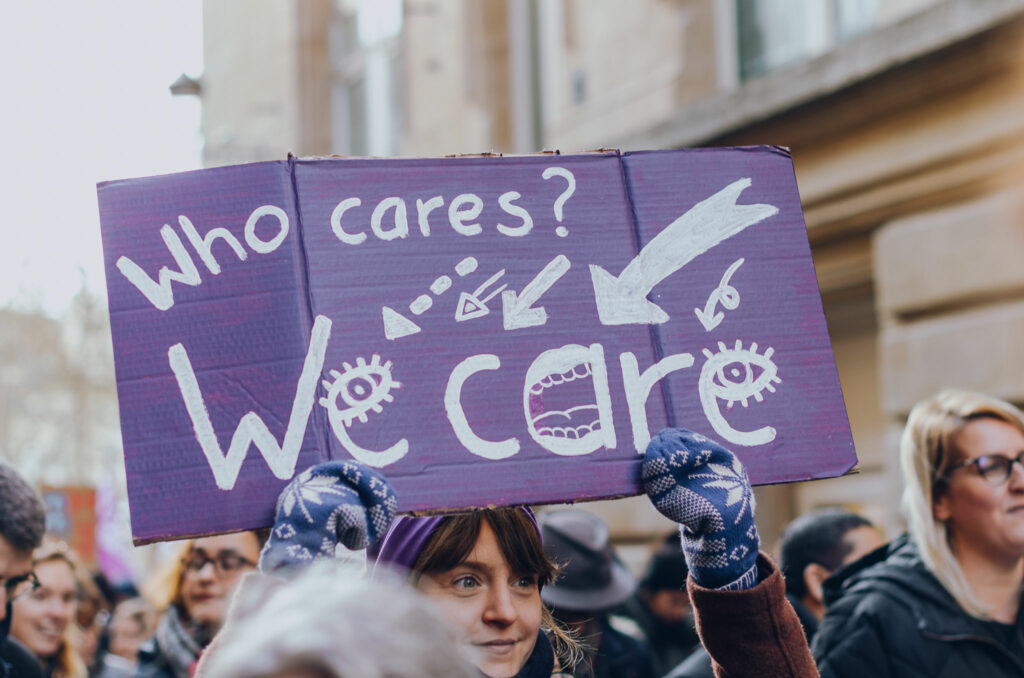
The JIF platform calls for a strike, joining international movements all over the world. The call for a strike is a strong reminder that the feminist movement and the labour movement go hand in hand and that women’s work is essential. Even though the law does not allow for an actual withdrawal from the workplace, the JIF insists on a political strike. Women’s work does not only take place in the paid workforce. In fact, a big portion of women’s work is unpaid and done in private. Women are called to step back from unpaid work in order to make it visible on the 8th of March.
The JIF platform was created in 2011 on the 100th anniversary of Women’s Rights Day. We have made a point of foregrounding the political dimension of the 8th of March and the achievements of feminism as a concept and a movement. The platform consists of organisations, political parties, trade unions and individuals. In 2022, for the third women’s strike, our demands are:
1. A real reduction in working hours for everyone. Women have no time for themselves and to participate fully in economic, social, cultural and political life. We call for a fair distribution of paid and unpaid work between everyone and a healthy work-life balance.
2. Three months of parental leave for everyone. The legal framework foresees that women stay at home and take care of their infant for at least three months while men go back to work after ten days. The law imposes normative family views as the second parent can only be a man, excluding lesbian couples. It also sends a clear message: women’s place is at home with the baby and men’s place at work. Models of parenthood have to be diversified and we need to ensure that both parents can be there for the first months of a child’s life.
3. A right to housing for everyone. Housing prices have reached record highs and have become a main concern. The housing crisis is rooted in the fact that a very small number of individuals and/or legal persons own the vast majority of the land available in Luxembourg for housing purposes. The price of rent increases constantly. Women have less money and therefore pay proportionally more in terms of rent than men. The situation is even more critical for young, old, immigrant, black, irregular, single mothers, victims of domestic violence and disabled women who, in addition to spending a large part of their income on housing, face constant discrimination when looking for a place to live.
4. Equal pay for everyone. Women earn less than men. These wage inequalities persist even though, in theory, equal pay has been enshrined in the labour code since 1974 in Luxembourg. Women earn 7.6% less on average than men for the same work and the difference is 44% in retirement. There are also six times more women than men working part-time. Women’s bargaining power needs to be increased and more transparency needs to be imposed by workplace inspectors.
5. A real fight against violence against women and gender-based violence. Violence against girls, women and gender minorities is one of the most widespread crimes in the world and is characterised by the fact that this form of violence is gender-based. While the sexist nature of these crimes is recognised in many countries, there is a lack of recognition at the political and legal level in Luxembourg. We need to recognise that these forms of violence are specific and gender-based and create an appropriate legal framework allowing the criminalisation of all forms of offenses linked to sexism.
Women have come a long way and have achieved substantial gains in rights in some parts of the world. The 8th of March allows us to commemorate all the women who have made this possible and focus on the ongoing struggles.
Find more information about the women’s strike on: https://fraestreik.lu
Jessica Lopes has a bachelor’s degree in Social and Educational Sciences from the University of Luxembourg and a master’s degree in Sociology from the University Institute of Lisbon. She is a social worker at the Association de soutien aux travailleurs immigrés (ASTI) – an association that advocates for migrants’ rights in Luxembourg. She has been a member of the Journée internationale des femmes (JIF) platform since 2019 where she has focused on the intersections of racism, capitalism and sexism.