

Radio Gaza at the festival of Palestinian music and culture
After the show is over, I sit down with Ayman Mghames, more commonly known as Abu Joury, which means Joury’s father (against the tradition he has chosen his oldest daughter’s rather than his son’s name as his teknonym). His love of Western music, which he got from his father, and of rap in particular is also unusual in Gaza, where he and the rest of Radio Gaza hail from. The rapper and songwriter is a bulky man with an open face and an easy smile, who is not fazed by an interview at this late hour. The band has just given an amazing performance at the Paul Barblé Cultural Center in Strassen[1], mixing traditional songs with rock and rap music. The other members of the group are Mohammed Alhabbash on the oud, Khamis Abushaban on bass, traditional singer and bouzouq player Moneim Adwan, Mohammed Lomani on electric guitar and Samer Abulaila on drums and percussion. Despite the high temperatures, the crowd has joined in with singing and dancing and the connection between the band and the room has been palpable. It’s past midnight now, and the band is winding down and tucking into the delicious Lebanese food that has also been enjoyed by the concert goers. Abu Joury momentarily looks preoccupied, he’s just had a message on his phone about his mother and brother, who are still in Gaza. His brother, who is critically ill with kidney and liver disease, has been admitted to hospital, but medical resources in Gaza are severely limited due to the Israeli occupation. He shows me a picture of an emaciated figure lying on a stretcher. ‘He used to be a kung fu coach.’ The next day he will get the devastating news that his brother has died.
All the band members are anxious about friends and relatives back in Gaza. ‘Every Palestinian has a story, a story of struggle, a story of pain, a story of agony, everyone. Each house, whether in Gaza, in the West Bank, in Israel, every house has a story of struggle’, Abu Joury explains. The trauma is generational. Abu Joury’s grandparents were not from Gaza, they had to flee their homes near Nazareth during the Nakba in 1948. His mother witnessed the invasion of Lebanon in 1982 and he himself was born in a Lebanese refugee camp.
His two children are the next generation to experience their story of struggle. The family’s flat on the 7th floor in the north-west of Gaza city was bombed by the Israeli army on October 17th 2023. Friends had warned him that the area was becoming unsafe as the Israeli army was approaching. Abu Joury, whose father was killed by Israeli bombs in a direct hit on his house in 2009, didn’t want to take any chances. He got his family out, but stayed nearby, worried about thieves. In the event, his apartment block was ‘levelled to the ground’ and nothing remained of the home he had ‘built from scratch, stone by stone’. It had been a dream of theirs to have their own place with the kids, but they only got to live there for three years. ‘It isn’t just about the money we put in the apartment, but our memories. My daughter, Joury, still remembers her room, she wants me to make the same room for her here. She still remembers her clothes.’ They had to move further south, to a refugee camp, where they stayed at a friend’s place until the beginning of January. ‘Then the occupation started saying that they would start bombing this area, so we had to move further south again.’ They ended up in an overcrowded UN school, but decided to leave after two weeks, when his wife discovered that she was pregnant. They bought a small tent for about 1000 euros and set it up in Rafah.
‚We created our own vibes in order to make the kids feel that they were not living a war.‘
Having seen the drawings by Gazan children exhibited by the organisation ‘Heart of Gaza’ just before the Radio Gaza concert, I was wondering how his children dealt with the situation. He explained that the Delia Art Foundation, who he worked for, and the French-Palestinian music education programme Al Kamandjâti[2] had set up a shelter for musicians and their families, which they were able to join. ‘They provided a calm and musical atmosphere for the families and the kids. The shelter was a big garden with tents. Every day we used to play sports, we used to go swimming in the sea. We created our own instruments, we sang, did a lot of activities, cooked together sometimes. We created our own vibes in order to make the kids feel that they were not living a war.’ He feels very lucky he was able to protect his children to some extent. The last three years have been particularly hard on Palestinian children. According to the UN report of 23rd June 2026, ‘Israeli authorities and security forces have deliberately targeted Palestinian children resulting in genocide, crimes against humanity and war crimes in the Gaza Strip and war crimes in the West Bank.’
In May 2024, Abu Joury, worried about his pregnant wife, managed to get his family as well as his sister, sister-in-law (who needed special medicine for her cancer that was not available in Gaza) and her two children into Egypt. Of course this wasn’t free. ‘We paid 62 000 dollars’. Where does all this money go? ‘You never know. It is people who know people who know people. It’s kind of a mafia.’ The family managed to escape in the nick of time. A week later, the border was closed for good and the Israeli army invaded Rafah and wiped it off the map.
‘Music has saved me’, Abu Joury explains – quite literally as he was offered a talent visa by the PAUSE programme (Programme d’Aide en Urgence des Scientifiques et des Artistes en Exil)[3], which enabled him to settle in France with his wife and now three children. Emotionally too, music helps him cope with his situation. One of his songs is called ‘Where should I go’, written while he was desperately trying to find a safe place in Gaza for his family, which of course did not exist. ‘Music is everything, it’s love, it’s peace, it’s anger, it’s political, it’s humanitarian, it’s everything. Whatever message you want you can deliver it through music. You just have to be honest.’
Even before October 7th life was not easy for musicians in Gaza. Stuck between a rock and a hard place, they had to contend with both the Israeli blockade, periodic bombings and shooting (friends of his were killed by the IDF) and the extremist Hamas government, who tried to ban music as much as possible. This meant no music education in schools, and private concerts could only be organised with special permission. There were conditions, for example women were not allowed to dance or to clap. ‘In Gaza, music is not a career’, Abu Joury laments. ‘Whatever you do, you will never find a chance.’ The political situation is difficult. There is no freedom of expression under Hamas (‘you would be killed or tortured’) and the Palestinian Authority ‘abandoned Gaza in 2007’. Abu Joury does not feel represented by any political group, but is convinced that ‘if there wasn’t an occupation, there wouldn’t be Hamas’.
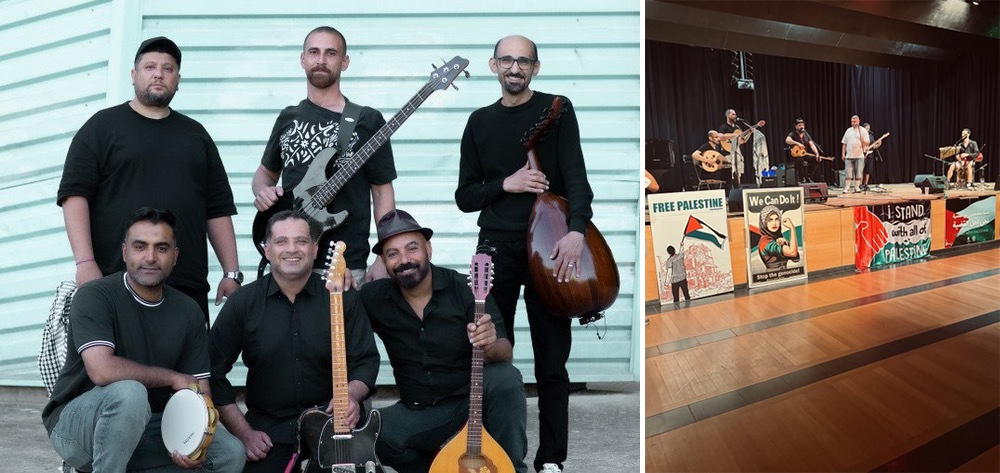
Meanwhile, he is rebuilding his life in Angers in France where he has been living since January 9th 2024. The musicians have been very happy with the support given by Al Kamandjâti. This has included help with housing, administrative procedures, medical care, school and daycare enrolment, and French language lessons, as well as in their artistic development by providing rehearsal and recording spaces, facilitating collaborations and connecting them with cultural institutions and artists. ‘We feel that we are not alone.’ They knew each other from Gaza, but they all had very different musical styles and at first pursued their own projects. Later on, they decided to ‘join efforts’ to present the Palestinian culture through music. Abu Joury is proud of the chemistry they have created by working together and learning from each other. It was difficult to come up with a name though that encompasses the wide range of music they wanted to play. ‘We were just chilling in a café in Angers and we told our friend Moneim about our idea of presenting Palestinian music, there is some rap, there is some traditional song, there is some rock and he was like, it’s kind of like a radio, just name it Radio Gaza.’ The name stuck.
The PAUSE programme is limited to December 2026 and after that Radio Gaza will have to manage on their own. They have used their time well, building contacts and performing over 80 concerts across Europe. Abu Joury is still amazed at the freedom of movement we take for granted in the EU. As a Gazan, he was unable to even visit other parts of Palestine, like the West Bank or Jerusalem, due to the Israeli blockade.
We have been talking for nearly an hour, I am thinking about the 800 kilometres he has to drive back to Angers the next day, it is time to end the interview. What is your message to the people who read this article and listen to your music? ‘First of all, I want you to enjoy the music. Second of all, listen to what our songs are about. Our songs are real, about displacement, about the brutality of the occupation, about the blockade, about the Arab countries that are doing nothing to help the Palestinians. All of our songs come from this background. This is how it is. We cannot beautify the reality. We are living in hell, we are living in agony and pain. This is our life and we cannot keep our mouths shut about it. We want people to enjoy our music, but we also deliver messages.’
For me, the band succeeded with both. I danced and sang and clapped along to their music and I was profoundly moved by their story, one of many stories of struggle. And once you have heard the story of Palestine, you cannot unhear it.
Nathalie Bintener is an English teacher in Luxembourg with a background in theatre. She is an activist for the environment, Palestine and human rights, and a member of CPJPO.
[1] The concert took place at the Centre Paul Barblé in Strassen on the 27th June 2026 and was organised by the Comité pour une paix juste au proche-orient.
[2] Al Kamandjâti Association was founded in 2002 in France (by the musician Ramzi Aburedwan) to provide music education to Palestinian children, and to strengthen their appreciation for Palestinian culture and identity. They organize cultural events in order to raise funds, collect musical instruments and teaching materials, and work on raising public support for creating music schools for Palestinian children. They also facilitate music studies in Europe for talented Palestinian students. https://www.alkamandjati.org
[3] PAUSE (Programme d’Aide en Urgence des Scientifiques et des Artistes en Exil) is a French programme whose aim it is to accommodate and protect researchers and artists from countries in which the political situation places their work and their families in danger. https://www.programmepause.fr/en