


Against the backdrop of the ongoing climate crisis, species extinction, and the general decline of biodiversity, the exhibition Living Thresholds: Towards Cohabitation in Architectural Design at LUCA
– Luxembourg Centre for Architecture maps the “interactions,” “entwinement,” and “entanglement” between humans, plants, and animals within our urban environments.1 The selected projects from Luxembourg and other European countries challenge common assumptions that consider wild animals and plants in urban environments as “nuisances” to be managed. Instead, they relate to these non-human living beings as what they have always been: our long-term cohabitants.
This article presents some of the exhibition’s theoretical and spatial “thresholds,” challenging the dominant anthropocentric approach to nature. Weaving together alternate narratives and places of encounters between human and non-human living beings, these speculative, critical and/or construction-oriented projects invite visitors to step into these beings’ territories. Reciprocally, the projects invite them to “becom[e] animal” themselves, borrowing from phenomenologist David Abram.2
Radical Architectures
Today’s resurgence of interest in living animals, plants, and soils within the field of architecture is not a new phenomenon.3 As early as the 1960s, amid the rise of environmentalism and sustainable design thinking at the height of modernist architecture,4 architects, like the Italian collectives Superstudio and Gruppo 9999, began incorporating living and/or photorealistic representations of animals, plants, and other natural elements
into their design projects. Juxtaposing sheep, cows, and salads alongside design furniture and technologically mediated environments, they not only “radically” challenged what they perceived as architecture’s inability to address complex issues and societal shortcomings, such as over-consumption.5 They also broke with a longstanding tradition of architectural representation, both in terms of how animals were depicted and mediums were referenced.
Unlike the predominantly metaphorical, structural, or functionalist use of animals and plants as design precedents in architectural history,6 radical architects depict non-human living beings as they are perceived in everyday life. Propelling them in a life-like manner ‒ that is, captured by a camera, rather than expressed through drawings or sculptural elements ‒ onto the 1960s design stage was novel, according to architectural scholar Dominique Rouillard.7
So was architects’ shift from a commission-oriented practice towards what members of Superstudio described as a “critical” and “speculative” approach to architectural design. Playing with irony and alternate mediums ‒ such as film, photographs, collages, etc. ‒, this approach challenges modernist architecture by contrasting natural elements, pastoral landscapes, and/or animals with monoliths and grid structures. It deconstructs architectural rationalism by pushing its most rational expression to the extreme: the Cartesian grid. Superstudio elaborates on the concept underpinning their conceptual designs. Structures, such as Supersuperficie (1972), are: “[…] not a three-dimensional model of reality that can be given concrete form by a transposition of scale, but a visual rendition of a critical attitude toward (or a hope for) the activity of designing, understood as philosophical speculation, as a means to knowledge, as critical existence.”8
Contemporaries of Superstudio, the collective Gruppo 9999 pushed speculative and critical design projects even further, integrating living plants directly into their architectural scenarios. While optimistic about technology’s potential to improve humans’ living conditions, these Italian designers were also deeply critical of its environmental costs.
Among the earliest advocates for what we now call “green energy,” Gruppo 9999 proposed alternative modes of cohabitation between nature and technology ‒ ones inspired by ecological harmony rather than resource extraction.9 Their project Casa Orto – Vegetable Garden House (1971-72) featured an indoor garden with cabbages, surrounded by immersive technologies, at the collective’s Florentine night club S-Space. This artificial space served as both a fictional and physical site of reconnection for humans with and through natural elements.
Bodies as critical mediators in contemporary architectural practices
This predilection for critical and speculative garden scenarios is also reflected in Studio Ossidiana’s Garden of Models (2025). To illustrate, consider the architectural office’s project Büyükada Songlines (2021): a barge-garden with custom-designed animal furniture and local flora, floating through the waters of the Sea of Marmara and the Bosphorus. As a place in constant flux, this carefully arranged environment playfully invites a diverse community – academics, fishermen, locals, researchers, animals, and plants – to collectively explore the political, ecological, and cultural dimensions of the aquatic ecosystems it crosses.10
Similar to Gruppo 9999’s use of vegetables, animals, and plants are not regarded as passive bystanders or mere props in Studio Ossidiana’s gardens. Affected themselves by the theatrical yet fully-functional set-ups, non-human living beings engage in a mediated relationship with humans, and vice versa. As mirrors for humans’ own actions, they quietly appeal to visitors’ capacity to reflect on their role as nature’s caretakers, both spatially and symbolically.
In Husos arquitecturas’ (Synanthro) Love Shack (2020), pine processionary moths also act as agents for “ecological and social transformation” through architectural design.11 Developed in collaboration with scientists and local residents, the project consists of a network of specifically designed bird and bat houses surrounding a fully-functional cabin for a non-heteronormative migrant couple in the mountains west of Madrid. As an alternative to chemical insecticides, these so-called “animal architectures” aim to curb the overpopulation of processionary moths by attracting their natural predators ‒ birds and bats ‒ through community-driven cohabitation between human and non-human living beings.12
Integrating other “sentient bodies” into their designs, the architectural office Husos arquitecturas also invites us to challenge our socio-cultural value and belief systems regarding nature. While Studio Ossidiana’s gardens playfully and poetically evoke a sense of responsibility and care, Husos arquitecturas directs its critique toward the anthropocentric view that classifies animals according to their usefulness.
Often dismissed as “pests” by humans, processionary moths are valued in this project for their role as protein sources for other animals. More precisely, they are recognized as active agents of the forest, providing an opportunity ‒ by attracting often displaced natural predators ‒ to locally help restore human-caused imbalances in the ecosystem. Although working at the scale of buildings, the office considers the planet as their primary site of intervention.
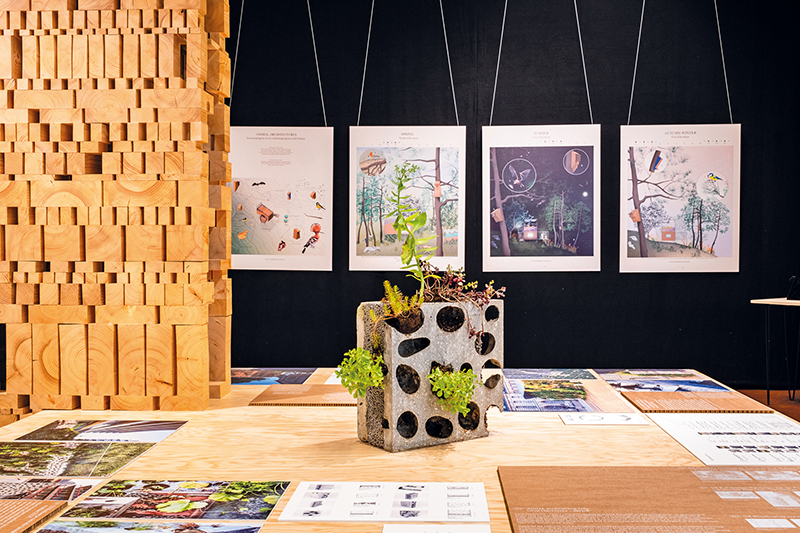
Others, like the architectural office ChartierDalix · serp, also challenge human-centered approaches to architectural design by directly incorporating animals, plants, and substrate into their buildings’ skin. The brick and dry-stone prototypes of what they call the “biodiverse walls” of Rue du Buffon in Paris (2021) exemplify the office’s ongoing research into this fundamental architectural element. What distinguishes ChartierDalix · serp’s designs from traditional green wall systems is the continuous inner layer of substrate between two vertical surfaces. Connecting the ground to the roof, it allows for the percolation of rainwater and the free movement of small animals. The joints and porous openings on the biodiverse wall’s outer layer allow local and indigenous plants to grow, creating pockets of biodiversity that flourish in urban areas. Meant to protect humans from nature, walls here become carriers for the quiet unfolding of life.13
Aestheticizing nature?
Incorporating non-human living beings’ needs into the design and construction processes is not synonymous with romanticizing the presence of animals and plants in our urban environments. Neither does it imply a return to a sublime or aestheticized view of nature, one which sees them as external to our everyday experience. Rather, integrating animals and plants into the very fabric of our discourses, buildings, and cities responds to a quiet yet urgent call to reconsider how we share the spaces we co-create with other species ‒ at a time when, according to the United Nations, more than half of the world’s population lives in urban areas.14
If urbanization has been beneficial for humans ‒ including improved access to healthcare, education, culture, and economic opportunities, etc. ‒ the ongoing soil artificialization and fragmentation of natural habitats have placed increasing pressure on non-human living beings. Expanding cities encroach on surrounding natural and agricultural lands. In turn, displaced animals, in search of new habitats and food sources, come closer to urban centers.15
Rather, integrating animals and plants into the very fabric of our discourses, buildings, and cities responds to a quiet yet urgent call to reconsider how we share the spaces we co-create with other species […].
The cartographic analysis of the City of Luxembourg’s green spaces and animal presences ‒ produced specifically for this exhibition using species observation data from Luxembourg’s National Museum of Natural History (2000-2025) ‒ appears to confirm this tendency. The data reveals that most animal species sightings occurred in the city’s green spaces, with the highest concentrations found in and around the Pétrusse and Alzette valleys. In this relatively unfragmented area, animals can breed and move more safely between interconnected patches of forests, parks, gardens, and riverbanks, while plants ‒ which offer food and shelter to many species ‒ can grow more undisturbed. With the exception of a few species, such as pigeons and rooks, the mapping also shows that a significantly lower number of animals were sighted on the heavily mineralized plateaus, such as the historic center or the Kirchberg district.
In light of rising temperatures driven by human-induced greenhouse gas emissions, the absence of green spaces in urban areas is problematic not only for animals but also for humans. More permeable surfaces and trees within these environments would help reduce the negative effects of urban warming on hot summer days ‒ by cooling cities, improving air quality, and mitigating flood risks. They would also improve humans’ health and well-being.16 Hence, cultivating “living thresholds” ‒ that is, places of encounter between human and non-human living beings ‒ is key to making our cities more resilient and sustainable. Caring for other living beings also means caring for ourselves.
Animals, again
If this exhibition seeks to give a voice to those beings which can’t be heard, it also appeals to our human capacity for Einfühlung (empathy). “Animals who exhibit life in highly concentrated and diverse forms,” architectural theorist Catherine Ingraham writes, “have the power to completely alter our way of thinking about ourselves, both the forms of ourselves and the forms we make.”17 They hold this power because they can alter the way we “feel” about the world we inhabit.

George Garofalakis (lead cartographer, GIS analysis, illustration), Nathalie Kerschen (scientific research, concept co-design), extract of the topographic basemap @ City of Luxembourg – Surveying and Geomatics department, species observation data (2000-25) @ Luxembourg National Museum of Natural History, additional geographic data sourced from Geoportail.lu (Licence Ouverte Etalab 2.0)
At a time when climate change denial has become part of political and cultural echo chambers,18 it can become increasingly difficult to fully grasp global warming’s scientifically-proven and/or projected impacts on everyday life. Large-scale phenomena, or what philosopher Timothy Morton calls “hyperobjects,” such as air or water pollution, concern us all. Yet, unless they personally affect us, they tend to remain at a distance.19
As the projects in this exhibition highlight, animals can play a foundational role in renewing our complex, and often abstract, relationships with nature. According to some phenomenologists, they possess the capacity to return the “gaze,” confronting us ‒ like a mirror ‒ with our own complacency and inaction. They also have the capacity to move us through the sentient ‒ that is, the “lived” body we share with them ‒ by appealing to our own felt experience.20 “Becoming animal,” Abram writes, is “a way of thinking enacted as much by the body as by the mind.”21 It is a way of empathetically designing cities shaped not only for humans, but with and alongside other species.
Taking place within the context of and supported by LUGA – Luxembourg Urban Garden 2025, the exhibition Living Thresholds: Towards Cohabitation in Architectural Design runs from June 27 to October 31 2025 at LUCA – Luxembourg Center for Architecture.
A trained architect, Nathalie Kerschen holds a PhD from McGill University (2023). As the curator of the exhibition Living Thresholds: Towards Cohabitation in Architectural Design, she works at the intersection between the arts, architecture, and academia in her research-creation practice.
1 While the term “interaction” is often used in the system sciences to describe emerging relations between parts, “entwinement” in phenomenology – similar to “entanglement” in eco-feminist theories – refers in this context to the ontological and/or socio-cultural encroachments between human and non-human living beings.
2 David Abram, Becoming Animal: An Earthly Cosmology, New York, Pantheon Books, 2010.
3 Since the 2020s, exhibitions, such as Cohabitation: A Manifesto for the Solidarity of Non-Humans in Urban Space (2021), Villes Vivantes (2022) or Paris-Animal (2023) point to shifting attitudes in relation to animality in contemporary design practices.
4 Philipp Tabb & A. Senem Deviren, The Greening of Architecture: A Critical History and Survey of Contemporary Sustainable Architecture and Urban Design, London, Routledge, 2016, p. 26.
5 “Radical” refers to a practice which challenges architecture’s client-based and construction-oriented modus operandi. For more, see Germano Clement in Emilio Ambasz (ed.), Italy: The New Domestic Landscape Achievements and Problems of Italian Design, Greenwich, New York Graphic Society, 1972, p. 385.
6 Philip Steadman, The Evolution of Designs: Biological Analogy in Architecture and the Applied Arts, Cambridge, Cambridge University Press, 1979.
7 Dominique Rouillard, “D’un animal à l’autre. Introduire la bête au système architecture”, in: Léa Mosconi et Henri Bony (eds.), Paris Animal : Histoire et récits d’une ville vivante, Vottem, Presses de l’imprimerie SNEL, 2023, p. 167.
8 Superstudio quoted in Ambasz (ed.), Italy, p. 242.
9 In Elettra Fiumi (dir.), Radical Landscapes, Documentary, Fiumi Studios & Film Affair, 2022.
10 For more, see https://www.studio-ossidiana.com/buyukada-songlines-istanbul-design-biennial (all websites referenced in this article were last accessed on July 21, 2025)
12 https://husos.info/Animal-Architectures
13 https://www.chartier-dalix.com/en/resources/prototypes-rue-buffon-paris-5
14 https://www.un.org/development/desa/pd/content/urbanization-0
15 Jennifer R. Wolch, Kathleen West, and Thomas E. Gaines, “Transspecies Urban Theory,” in: Environment and Planning D: Society and Space, 13 (1995), n° 6, p. 735.
17 Catherine Ingraham, Architecture, Animal, Human: The Asymmetrical Condition, London, Routledge, 2006, p. 15.
18 https://www.theguardian.com/environment/2025/jul/04/europe-heatwaves-failing-support-climate-action
19 Timothy Morton, Hyperobjects: Philosophy and Ecology after the End of the World, Minneapolis, University of Minnesota Press, 2013, p. 12.
20 Maurice Merleau-Ponty, Nature: Course Notes from the Collège de France, Evanston, Northwestern University Press, 2003. See also, John Berger, Why Look at Animals? London, Penguin Books Ltd, 2009.
21 Abram, Becoming Animal, p. 3-4.