


Introduction
The durational solo performance On Line – A Manifestation of the Human Border (2018) took place in the aftermath of the 2015 European migrant crisis, during which national borders and the “Fortress Europe” became central themes in global discourse.
On 9th June 2018, I embarked on an expedition along the geopolitical border of Luxembourg, my home country. Hiking with only a backpack and sleeping in a tent on the border, my goal was to trace the borderline as precisely as (humanly) possible. The journey began and ended in Schengen, the symbolic tripoint where the Schengen Agreement was signed in 1985 and came into effect in 1995.
Over the course of 26 days and approximately 400 kilometres, I navigated with GPS for accuracy while remaining otherwise offline. I refrained from using social media, music, or books, choosing instead to keep a journal. This self-imposed isolation was crucial for fully immersing myself in the experience. Beyond the geopolitical border, I confronted emotional, mental, and physical boundaries.
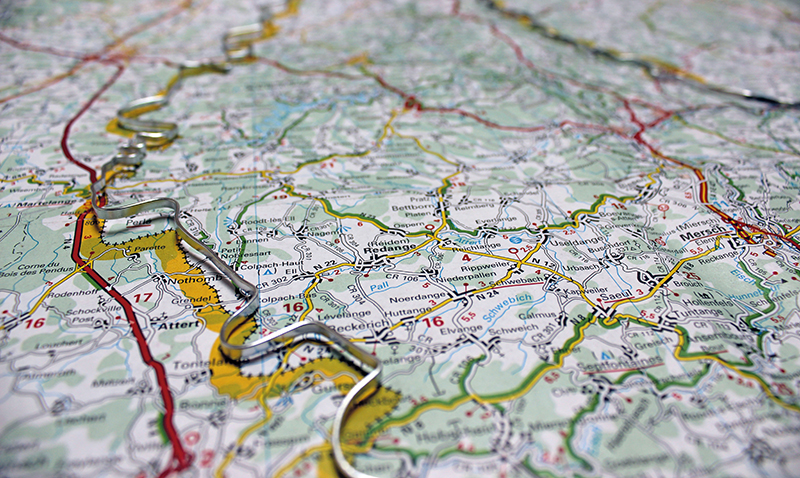
The public could track my progress in real time, either online or on a screen at the Musée d’Art Moderne Grand-Duc Jean (MUDAM). A digital map displayed my route, colour-coded based on proximity to the actual border: green for 0-3 metres, orange for 3-10 metres, and red for more than 10 metres of distance from the borderline.
On Line – A Manifestation of the Human Border is a performative investigation into borders as social, political, and geographic constructs and their impact on shaping identities and realities. By walking the border, I sought to transform an abstract geopolitical line into an empirical, embodied research.
The documentary Three Borders, directed by Catherine Dauphin, offers an insight into this experience, providing a videographic perspective on the expedition.
Walking as an Artistic Practice
“Walking is the speed for noticing – and for thinking.” (Anna Tsing, 2015)1
Walking has been central to my artistic practice ‒ sometimes on the periphery, sometimes at the core. It is more than mere movement; it is a method of inquiry, a way to engage with space through presence and perception. Walking and thinking intertwine, shaping an embodied research process where the act of moving generates reflections. As Anna Tsing suggests, walking allows for deep noticing, fostering a rhythm of thought (Gedankengang) that emerges through physical engagement with the landscape.
Navigating the unfamiliar – physically, intellectually, and emotionally – requires both humility and exploration. As I walked the border, I followed a line that existed concretely only on maps, often invisible in the terrain. Guided by GPS but frequently misled by the arbitrary constructs of human geography, I had to carve my own path, making tangible the often abstract nature of borders.
Walking, then, becomes more than a mode of travel; it is a form of artistic inscription upon the landscape, a meditation on place, movement, and the fluidity of boundaries. The border, usually perceived as a fixed geopolitical entity, transforms into a dynamic space of questioning – challenging notions of nationality, identity, and belonging with every step. Walking, in its simplest form, resists commodification; it demands attention, patience, and engagement.
Durational performance, as pioneered by Tehching Hsieh, Marina Abramović and Ulay, or later Francis Alÿs with his work The Green Line (2004)2, serves as a crucial framework for On Line. Hsieh’s year-long performances, such as One Year Performance 1981–1982 (Outdoor Piece)3, in which he lived without shelter, tested the limits of human endurance and redefined artistic labour as an existential commitment. Similarly, On Line was shaped by the physical and psychological demands of prolonged exposure to nature, uncertainty, and solitude.
Abramović and Ulay’s The Lovers: The Great Wall Walk (1988)4, in which they walked from opposite ends of the Great Wall of China to meet in the middle, serves as another relevant reference. Their project, initially conceived as a celebration of love, became a ritual of separation. My journey, in contrast, was about tracing an external border rather than meeting at a centre – yet both works explore movement as a means of transformation. Walking became a method of measuring space and experiencing time.
Phenomenology of Walking
Drawing from Maurice Merleau-Ponty’s phenomenology5, the experience of walking foregrounds the body as both subject and medium. Walking is not merely a means of transportation but an embodied epistemology. As Ingold and Vergunst (2008) assert, walking is “not just what a body does; it is what a body is”. 6
Each step reinforced an acute awareness of my surroundings – the texture of the terrain, the shifting weather, the play of light and shadow. The landscape was not a static backdrop but an active participant, shaping and being shaped by my movement. This aligns with the post-representational turn in geography, which critiques fixed representations and emphasises embodied, multisensory experiences of space.
The physical strain was a core aspect of the project. My feet, an often underestimated part of the body, became central to the journey. The ritual of applying balm to soothe them symbolised the symbiotic relationship between the body and terrain. The expedition pushed me to my physical and mental limits: enduring the cold of the night and the morning dew, navigating rough and steep terrain and searching for safe places to sleep took a toll on my mental condition.
The Border as a Site of Inquiry
Borders are often depicted as rigid and definitive, yet they revealed themselves to be porous and fluid throughout my journey. My experience echoed Michel de Certeau’s (1984)7 distinction between the cartographer’s abstract, elevated perspective and the pedestrian’s lived, embodied reality. What appeared as a precise line on the map dissolved in the terrain, where only rivers and border stones provided tangible demarcations. Walking became an act of resistance – a refusal to accept the border as a given, questioning its arbitrary imposition. I experienced the border as oscillating between an imposed constraint and an open-ended investigation, shaping both my path and perception.
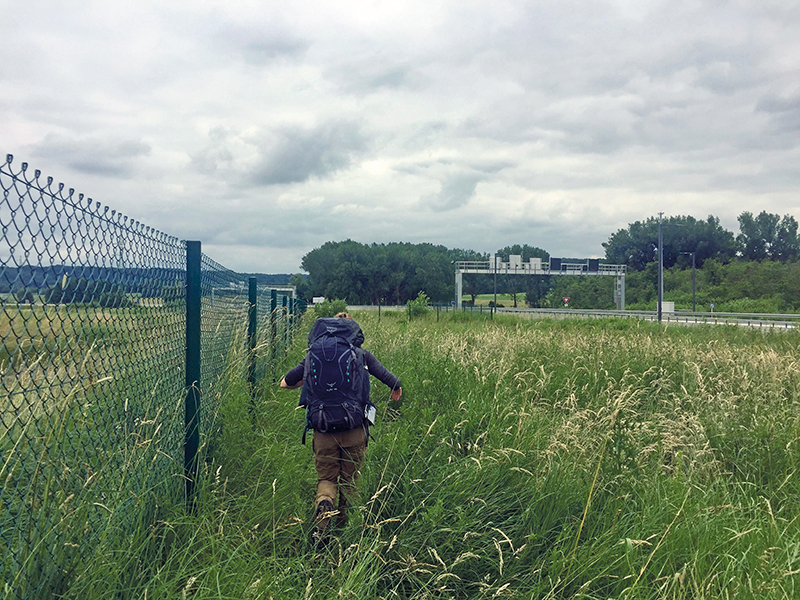
This shifting nature of borders became evident as I traversed private properties, scaled fences, waded through streams and navigated peripheral fields and forests inhabited by cattle and wildlife. Rather than an impermeable barrier, the border emerged as a fluctuating entity – sometimes guiding, sometimes obstructing. It dictated my rhythm and itinerary, influencing decisions about finding water, shelter and orientation before nightfall. Over time, I adapted: my body adjusted to the terrain, my inner rhythm and breathing synchronised with the act of walking and my awareness deepened into a state of radical presence.
The expedition also highlighted the privilege of voluntary movement. Walking the Luxembourg border from a place of safety drew a stark contrast between exploration by choice and displacement by necessity. The ongoing refugee crisis was a constant reminder of the disparities: while I pursued an artistic inquiry, others are forced to confront borders as immovable, life-altering barriers.
A Queer Feminist Perspective on Borders and Embodiment
Queering Borders: Fluidity and Disruption
Borders function as state-imposed constructs designed to regulate movement and define national identity. In contrast, queer theory critically questions and destabilises fixed categories – whether of gender, sexuality, or territory. By walking the Luxembourgish border, I reclaim the border as an unfixed, permeable and ambiguous space. My path frequently diverged from the official cartographic line, revealing the constructed nature of borders and aligning with queer spatial theories that examine the conception and experience of space and resist dominant territorial logics.
The durational aspect of On Line also queers time. As Jack Halberstam (2005)8 argues, queer temporality resists capitalist and heteronormative timelines structured around productivity, accumulation, and reproduction. By committing to an unpredictable, physically and mentally demanding journey, my performance embraced an alternative temporality – one that values slowness, presence, ambiguity, and endurance over efficiency.
Embodiment and the Feminist Politics of Walking
Walking as an artistic and political act has historically been gendered male, associated with figures like the flâneur (Baudelaire, Benjamin) or land artists such as Richard Long. However, as Rebecca Solnit (2000)9 highlights, women’s movement in public space is shaped by vulnerability, surveillance and restriction. As a queer woman walking alone, I confronted both the liberatory and precarious dimensions of solo movement. The refusal of external comforts – no music, no books, no digital distractions – amplified the embodied experience, making the body itself the site of negotiation between freedom and constraint.
By positioning the body as central to the experience, On Line echoes feminist phenomenological thought, particularly the work of Sara Ahmed and Judith Butler10. Ahmed (2006)11 argues that bodies are shaped by the spaces they move through, while Butler’s theories of performativity suggest that identity is constructed through repeated acts. Walking the border, thus, is an iterative process that with each step actively reshapes my relationship to borders, identity, and spatial belonging.
Conclusion: Beyond the Line
Ultimately, On Line was not about reaching conclusions but about inhabiting questions. What does it mean to take borders literally and walk them? What does it reveal about the human relationship to space, identity and movement? The experience underscored the entanglement of the personal and the political, the physical and the conceptual, the seen and the unseen.
As de Certeau reminds us, walking is an act that both affirms and transgresses, respects and reconfigures. By walking the border, I sought not to define it but to encounter it – not as a line of separation, but as a space of inquiry, where movement itself becomes meaning.
Through duration, physical endurance and radical attention, On Line challenges the assumption that borders – like identity –
are natural and fixed. Instead, it reveals them as fluid, performative and open to reimagination.
The border closures within Europe during the COVID-19 pandemic and the current rise of right-wing nationalist policies highlight the need to not take acquired rights for granted and the importance of collective attention and effort.
1 Anna Tsing 2015, The Mushroom at the End of the World: On the Possibility of Life in Capitalist Ruins, Princeton, New Jersey, Princeton University Press, 2015.
2 Francis Alÿs, The Green Line [live performance], Jerusalem, Israel, 2004.
3 Tehching Hsieh, Outdoor Piece [live performance], New York, USA, 1981–1982.
4 Marina Abramovic and Ulay, The Lovers: The Great Wall Walk [live performance], Great Wall, China, 1988.
5 Maurice Merleau-Ponty, La Phénoménologie de la perception, Paris, NRF Gallimard, 1945.
6 Jo Lee Vergunst and Tim Ingold, Ways of Walking. Ethnography and Practice on Foot, New York, Routledge, 2008, p. 2.
7 Michel de Certeau, L’invention du quotidien,
tome I: Arts de faire, Paris, Gallimard, 1990.
8 Jack Halberstam, In a Queer Time and Place: Transgender Bodies, Subcultural Lives, New York, New York University Press, 2005.
9 Rebecca Solnit, Wanderlust: A History of Walking, New York, Penguin Books, 2000.
10 Judith Butler, Gender trouble: feminism and the subversion of identity, New York, Routledge, 1990.
11 Sara Ahmed, Queer Phenomenology: Orientation, Objects, Others, Durham, Duke University Press, 2006.
Clio Van Aerde is a Belgo-Luxembourgish performance artist and scenographer based in Luxembourg, working across Europe. Trained in performance practices and scenography in Arnhem (NL) and Vienna (AT), her work spans multiple disciplines, including expanded choreography, site-specific art, durational art, and visual arts. Her practice centers on embodied experiences and a keen awareness of space, employing a rhizomatic approach to explore the subtle dynamics of everyday life.