


The petition
In 2014, a public petition gained traction in Luxembourg. It targeted the drive hunt of pilot whales and in the Faroe Islands. Every year, the gruesome footage of blood-tainted waters causes an international uproar. This particular petition called on the Luxembourgish Government to exert international pressure on Denmark to put an end to these grim hunts, which for many hold no place in today’s society.
As a budding marine biologist, I was thrilled to see Luxembourgish people rally behind a marine conservation cause. All too often, our landlocked-country syndrome prevents us from feeling concerned about ocean related issues. At the time, I was working on my master’s thesis on the effect of environmental conditions on fin whales, a topic that I would later pursue during my PhD degree. I should have jumped at the opportunity to add my signature to the petition without hesitation, yet I paused.
The whaling controversy is a highly emotive topic, not least because of the fascinating lives of whales and dolphins. Species like killer whales, pilot whales, and sperm whales form livelong bonds in matrilineal groups and share care-giving responsibilities within groups. In some cetaceans (marine mammals like whales, dolphins, and porpoises), knowledge of hunting techniques is passed on to offspring or conspecifics, seen as evidence for cultural transmission. Immersed in my scientific training, I therefore tried to see beyond my emotional response to examine arguments of conservation, tradition, and ethics.
Commercial and subsistence whaling
From a conservation perspective, the main concern is that the annual take of animals, which in the Faroe Islands averages 640 pilot whales per year, is not sustainable and causes a population collapse, as happened during industrial whaling operations in the past. Whaling peaked in the 1960s when 80 000 whales were hunted, pushing species like fin and blue whales to the brink of extinction. It was only once whaling was no longer economically lucrative that whaling nations agreed to enforce catch limits in attempts to preserve the remaining stocks through the International Whaling Commission (IWC). In 1986, the moratorium on whaling came into force, which was supposed to be a ten-year pause on commercial whaling to allow recovery of whale populations. However, a shift in attitudes towards the acceptability of whaling and slow recovery meant that the moratorium was never lifted.
Despite what the “dolphin-safe” labels may try to portray, fishing in European waters often continues to pose significant threats to marine life, including bycatch of dolphins, as well as damage to sensitive marine ecosystems through practices like bottom trawling.
Iceland and Norway continued their commercial whaling programmes under reservation or objection, and Japan exploited over many years a loophole which stipulated that whaling could be permissible for scientific purposes. After years of failed attempts of negotiating a resumption of commercial whaling, Japan left the IWC in 2019 and has since resumed limited whaling operations in its territorial waters and exclusive economic zone.
The moratorium does not apply to small cetaceans, like pilot whales, or to aboriginal subsistence whaling of native peoples for whom whale products are nutritionally and culturally an integral part of their lives. Dissatisfied with how the IWC had been managing marine mammal resources, Norway, Iceland, Greenland and the Faroe Islands created their own regional body for cooperation on conservation, management and study of all marine mammals in the North Atlantic in 1992. The North Atlantic Marine Mammal Commission (NAMMCO) is very outspoken about marine mammals being a resource, acknowledging the rights and needs of coastal communities to make a sustainable living from what the sea can provide. NAMMCO bases its management decisions on the best available scientific evidence to ensure sustainability. It participates in extensive ship and aerial surveys that are conducted at regular intervals, providing some of the best estimates on the numbers and trends of whales and dolphins in the North Atlantic.
For the pilot whales, a target population of 50 000 to 80 000 animals is required to sustain annual catches of 680 pilot whales. Surveys from 2015 estimated a total population size of 340 000 pilot whales, well above the sustainable limits. The pilot whales in the North Atlantic are listed as “Least Concern” on the Red List of Threatened Species, which is a status given to species that are still plentiful. Archaeological evidence suggests that these islanders have been whaling for many centuries, strengthening their argument that the drive hunts are part of their cultural heritage. So far, no population crash has been observed, but an updated assessment of the sustainability of the Faroese catches is planned for 2025 and will integrate the results of the most recent whale surveys conducted in 2024.
Among the great whales, humpback, fin, and minke whales have largely recovered thanks to the moratorium on commercial whaling, but others like the blue whales and North Atlantic right whales never rebounded and remain at risk. The Faroese drive hunts are in scale very different from the industrial whaling that decimated great whales. Numbers, trends, or probability of extinction are, of course, a very scientific way of looking at this topic. Some will argue that no matter how sustainable the catches may be for the species overall, the suffering that the individual whales have to endure is simply inadmissible and unethical.
On ethics and public opinion
Not least since the “Save the Whale” campaigns by Greenpeace and Sea Shepherd Conservation Society in the 1970s did the ethical debates about whaling reach the wider public. For a long time, whales had been portrayed as sea monsters, think of Ahab’s ferocious arch-enemy Moby Dick that vindictively sank whaling ships. However, the release of Roger Payne’s album Songs of the Humpback Whale and the series Flipper helped to give whales and dolphins a PR makeover that tipped the public opinions in favour of their conservation rather than persecution. Scientific discoveries on the social bonds, intelligence, and vocal repertoire further enchanted people.
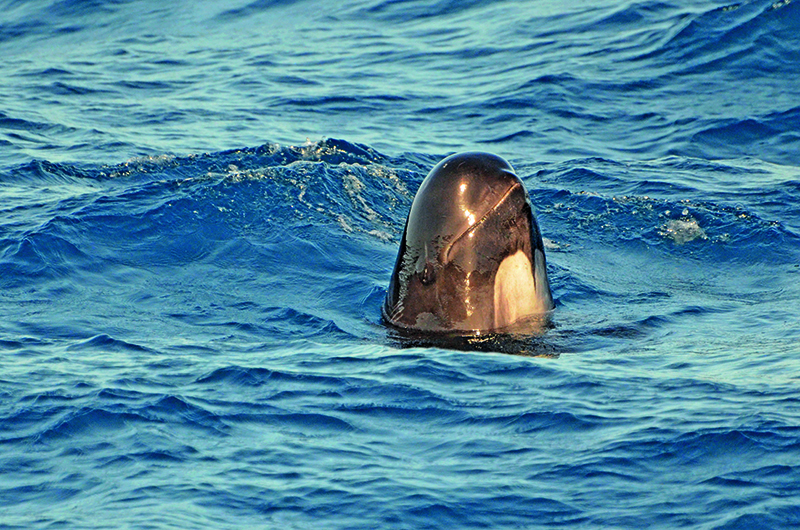
Given the high popularity of the animals, it should come as no surprise that pictures of hoarded pilot whales in blood-red waters or the firing of explosive harpoons on large whales are distressing. The fact that harpoons are becoming increasingly efficient, and the Faroese have adapted their killing methods to reduce prolonged suffering probably offers little consolation to most.
One could argue that at least the pilot whales get to enjoy roaming free with their family before they meet their tragic end, a privilege that is not afforded to many farm animals that pass from their sad farm pens to slaughterhouses. Our emotional response may in part result from the dissociation of meat and its animal origins, which entails that we are very rarely confronted anymore with the slaughtering process that happens out of sight.
Organisations like Sea Shepherd or the late Captain Paul Watson Foundation hold the uncompromising view that they oppose the killing of any whale, by anyone, anywhere, for any reason, without exception. They conduct their campaigns to block whaling practices with so-called “non-violent aggressions” (if you can call ramming and sinking another ship non-violent) and favour direct action over diplomacy. Their presence in the Faroe Islands is met with resistance from the locals, some even claiming that the activists’ interference has only emboldened locals who continue their practices in defiance. However, time will tell whether the Faroe Islands can maintain their practices under growing international pressure and disruptive campaigns.
While one could expect that the Faroese will abandon the hunt at some point out of their own will, divisive campaigns to stop the Faroese from killing pilot whales may create a distraction from the far greater human-caused threats to marine mammals. With their provoking imagery, the campaigns divert attention and finances from environmental issues that are genuinely driving species to extinction. Similarly, in the case of the Luxembourgish public petition, the issue of whaling in the Faroe Islands was prominently discussed. However, the momentum should have been used to raise awareness about broader marine conservation issues and Luxembourg’s role and responsibilities in minimising its impact on the ocean.
We are all whalers
By far the greatest threat to whales and dolphins these days is the fishing industry. Fisheries are the primary cause of the precipitous declines in populations like the vaquita, a small porpoise in the Gulf of California, and the North Atlantic right whales. Their habitats unfortunately overlap with fishing grounds leading to frequent entanglements in fishing gear. Only about 10 vaquita remain and so far, all attempts to halt its extinction, including designations of protected areas or fishermen buy-out schemes, have failed. At a scientific conference in 2018, the leading scientists recounted their last-ditch efforts to capture the few remaining animals to place them in captivity for safeguarding. Despite taking the greatest precautions, one captured female died from stress and the mission was aborted. The scientists were in tears as they apologised to the community for failing to protect the vaquita as I remember the room slowly coming to the realisation that this was the vaquita’s death sentence.
If nothing changes, the North Atlantic right whale may face a similar fate. Approximately 370 individuals remain, including fewer than 70 reproductively active females. Death from vessel strikes and entanglements has outpaced the number of births in recent years, setting the species on a path to extinction. It is extremely disheartening to witness this demise even though the very causes are known. The whales seem to be the unlucky losers in failed efforts to balance the push for fisheries profit versus the prevention of entanglements. However, there is hope. Dedicated scientists on tiny planes survey the coastal waters off Canada and the United States and inform authorities on the location of the critically endangered animals. Detections cause a temporary closure of fishing grounds and mandatory vessel speed reductions. Technological advances to develop ropeless fishing and the acoustic tracking of whale migrations also give reason for cautious optimism.
Despite what the “dolphin-safe” labels may try to portray, fishing in European waters often continues to pose significant threats to marine life, including bycatch of dolphins, as well as damage to sensitive marine ecosystems through practices like bottom trawling. In the Bay of Biscay, an estimated 9 000 common dolphins died between 2019 and 2021 in fisheries. In Danish waters in the North Sea, more than 2 000 harbour porpoises are estimated to fall victim to gillnets every year. We are all whalers is the thought-provoking title of Michael J. Moore’s book in which the scientist argues that we are complicit in the deaths of whales and dolphins because eating commercially caught seafood leads to whales’ entanglement and slow death in rope and nets, and the global shipping routes that bring us readily available goods often lead to death by collision.
The role of Luxembourg
In 2005 Luxembourg became a member of the IWC whose mandate now also includes conservation programmes on bycatch and entanglement, ship strikes, ocean noise, and pollution. At the 2024 IWC meeting, the proposal of a South Atlantic Whale Sanctuary (first introduced in 1998) obtained 74 % of votes, thereby missing the proposal’s approval by a mere 1 %, hinging on a couple of votes. This highlights the critical importance of Luxembourg’s vote in support of whale conservation, as ongoing efforts to overturn the moratorium continue to jeopardize the recovery of whale populations.
Luxembourg is also a member of the Global Ocean Alliance to show its support of the ambitious target to effectively conserve and manage at least 30 % of the global ocean by 2030 through a network of Marine Protected Areas. In 2023, Luxembourg was among 105 countries to sign the historic High Seas Treaty to prevent biodiversity loss and tackle environmental degradation. The EU and its Member States have committed to ratifying the Treaty before the next UN Ocean conference in June 2025. In the framework of the National Plan for the Protection of Nature (PNPN3), Luxembourg has also pledged to adhere to the scientific committee on Antarctic research as well as the Convention for the Conservation of Antarctic Marine Living Resources.
Despite international commitments, there is still much work to be done at the national level to raise awareness about the importance of a healthy ocean and the impact our consumption habits and industries have on marine biodiversity. Luxembourg’s growing appetite for fish ranks among the highest in Europe, a trend that is increasingly unsustainable. This staggering demand for seafood reflects how fish, once considered a delicacy reserved for special occasions, has become a commodity found in sushi boxes at petrol stations or poke bowls during lunch breaks. Reframing our relationship with seafood by valuing it as an occasional precious resource rather than a staple would help promote more sustainable practices at the benefit of healthier marine ecosystems and whale and dolphin populations.
In 2013, I co-founded the association Odyssea ASBL to promote marine conservation and research. We have created a network of Luxembourgish marine scientists that are conducting fascinating research on coral reefs, microplastics, turtle conservation, and oceanography. Our goal is to raise awareness about the state of the ocean with workshops on sustainable fishing, climate crisis, and plastic pollution. Marine conservation in Luxembourg remains a neglected topic, but as the pioneering marine advocate Sylvia Earle put it: “Knowing is the key to caring, and with caring there is hope that people will be motivated to take positive actions. They might not care even if they know, but they can’t care if they are unaware.”
Dr Anna Schleimer is the co-founder and president of the Luxembourgish marine biology association Odyssea ASBL. Her academic research focuses on the genetic connectivity and population trends in fin whales.