


Portraits of Plants, the exhibition of photographs in the Parc de Merl by the internationally renowned Marianne Majerus, is selected from the large body of work she has produced during her distinguished career. The exhibition comprises large reproductions of her plant portraits set outdoors against the backdrop of natural surroundings.
Nature has long been a source of inspiration for artists and photographers alike. In 1844, William Henry Fox Talbot, the inventor of calotype photography, included a close-up of a leaf in The Pencil of Nature, the world’s first commercially published book of photographs. In the 1920s, the German photographer and sculptor Karl Blossfeldt published Urformen der Kunst and Wundergarten der Natur, showcasing the extraordinary beauty of organic forms. His approach, associated with the New Objectivity movement, was characterised by a unique artistic style based on scientific accuracy and a focus on recurring geometric patterns. In his seventies, nature photography became Paul Strand’s exclusive subject. Despite losing his sight, he continued to capture the details of flora in his garden with the invaluable help from his assistant. An obsessive passion for flowers can also be found in the erotically suggestive works of contemporary photographer Robert Mapplethorpe.
Unsurprisingly, both photography and gardens have been accused of imitating something else. The relationship of photography to truth and “the real world” has been questioned since the very beginning of the medium. Conversely, gardens are criticised for their tenuous relation to nature. However, gardens were never intended to imitate nature exactly. Instead, they are viewed as paradises ‒ ideal spaces whose purpose transcends the practical. They evoke the biblical Garden of Eden: a symbolic space for contemplation and meditation. Yet both photography and gardens have another surprising feature in common: they depend greatly on light and human input to flourish.
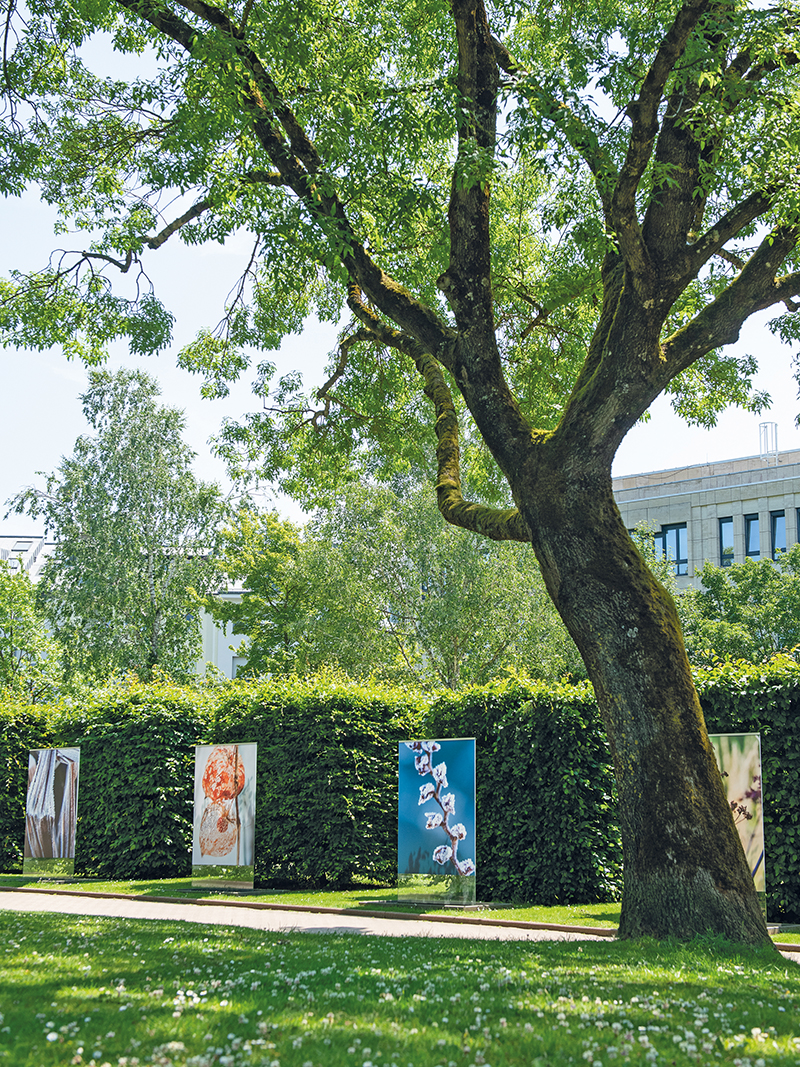
Marianne’s photographs of plants and gardens clearly depict the perpetual cycle of death and rebirth. In each subsequent photograph, the seemingly dead world begins to come back to life, absorbing the joy of growth and renewal. The photographer’s curious gaze confronts us with the stunning beauty of organic details that are usually overlooked in the racing modern world. This beauty is not always obvious: the surprising charm of wilting nature and plants dying rather than blooming. The viewer is led from the freshness of spring and summer, magnified by the lush surroundings of the Parc de Merl, to the silent, contemplative nature of hibernation and standstill. Winter is a time of dormancy and reflection, bringing profound and insightful moments to our human existence. “Gardeners know that everything is ephemeral: they work with the cycle of life. Growing, becoming, fading and returning to earth. I think gardens can help us to accept the phases of existence, to be serene in the face of what cannot be changed”, explains Marianne in her latest book, Garden Photography: The Art of the Ephemeral.1
According to Joel Meyerowitz, turning to nature is “an age-appropriate thing”.2 Aging creates a certain kind of vulnerability as we consider death more. The beauty of decay is omnipresent in nature. It provides us with an immediate sense of our own mortality and the fragility of existence, which remains within safe and manageable boundaries, especially in gardens. Cultivating the land and caring for plants is a rewarding creative act that fulfils one of our basic needs ‒ to feel useful. Marianne Majerus also considers it an “act of faith in the future”. In her own words: “Gardeners are a bridge between generations. The echoes of our ancestors, the nurturing people of the past. Gardeners plant trees for people who will come long after them.”3
1 Marianne Majerus, Garden Photography: The Art of the Ephemeral, Luxembourg, Editions Guy Binsfeld, 2025, p. 9.
2 Essay by Joel Meyerowitz, in: Paul Strand: The Garden at Orgeval, New York, Aperture, 2022, p. 4.
3 Majerus, Garden Photography, p. 9.
Krystyna Dul is a Polish-Luxembourgish artist, cultural coordinator and independent curator. She has an MA in Political Science and in Creative Photography, Film, Television, Photographic Art and New Media. Her work has been exhibited in several European countries, including a presentation at Les Rencontres de la photographie in Arles, France.